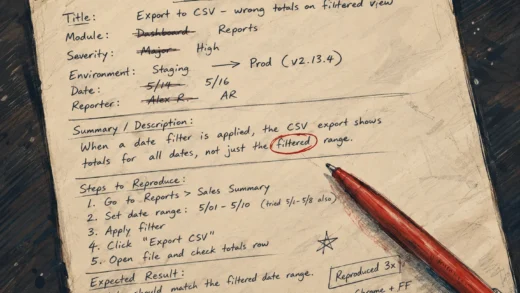
A Bug Report Is How You Communicate Risk

Most QAs think reporting a bug means opening Jira. And sure, Jira works. But that framing limits your options.
A bug is just information about a risk — here’s something wrong, here’s how bad it could be, here’s what we should do about it. And information doesn’t care how it travels. As long as the right person receives it clearly and can act on it, you’ve done your job.
Which means you have more options than you think.
The Standard: Jira
I’ll start with what you already know. Jira is probably the most common approach because modern scrum teams have embraced it to organize and plan their work. You get a clear title, a description with reproduction steps, and the ability to attach screenshots, videos, and logs. One place to track everything.
That said — I’d be lying if I said I enjoy filing bug tickets. A single ticket can take me upwards of 15 minutes, and it always feels like an interruption to my actual testing. Which is exactly why it’s worth knowing the alternatives.
Slack
Have you ever shot a quick Slack message to a product manager just to confirm whether something is actually a bug before filing it? I have, and it’s great. If they tell me it’s working as designed, I just saved 15 minutes of Jira time.
Slack really shines in high-urgency situations. During a big launch where we were war-rooming and testing live, Slack was the go-to for reporting production issues. The moment we spotted something wrong, we’d ping the on-call person and they’d route it to the right dev team instantly. No ticket needed.
The downside is that bugs get buried as messages pile up. Slack is best for quick feedback or urgent situations — not long-term tracking. If something is real, move it to Jira eventually.
Video Call
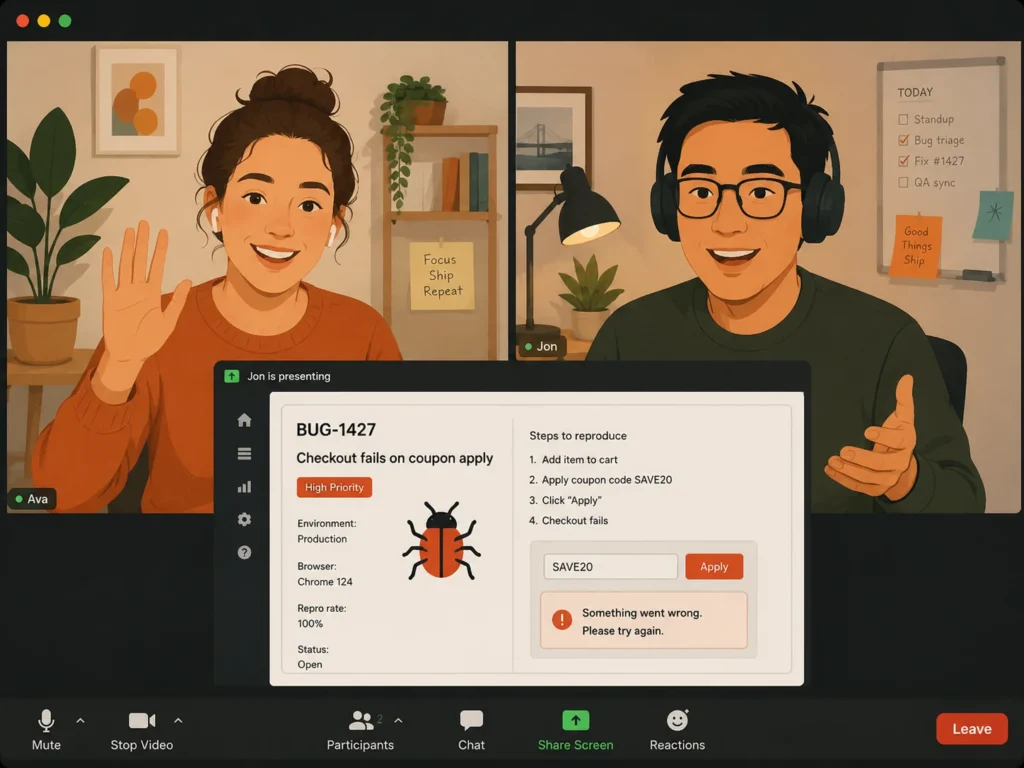
Sometimes a written report just isn’t enough. I once wrote what I thought was a very clear Jira ticket, but my teammate across the Atlantic struggled to follow it — English wasn’t their first language, and the text description wasn’t translating well. A quick Zoom call where I shared my screen and reproduced the bug live fixed it instantly. No way to misinterpret what you’re seeing in real time.
The tradeoff is obvious: you’re adding a meeting to both your calendars. Worth batching issues before setting one up. And anything discussed on the call should be documented somewhere afterward, or it’s gone.
I don’t reach for email often, but it has its place. I’ve used it when working as a testing vendor where the client preferred email updates on testing status and issues. I’ve also used it to report bugs to external vendors when I wasn’t in their Jira or Slack.
For internal teams, email has the same long-term tracking problem as Slack — things get lost. But if your stakeholders just want to know what issues exist and don’t need a full tracking trail, email gets the job done. Bugs are just information. Email is a perfectly fine way to send information.
In Person
If you’re not an introvert, walking up to the developer or product manager is the fastest option of all. On a small startup team working out of a WeWork, I did this constantly. A developer pushed a hotfix, I tested it, found a new bug, and just leaned over and told them. They saw it immediately and pushed another fix. No ticket, no Slack thread, no meeting — just two people looking at the same screen.
This doesn’t scale, and nothing gets tracked. But for quick smoke tests or small teams in the same room, it’s hard to beat.
Each approach has a different sweet spot:
| Method | Speed | Clarity | Trackability | Best for |
|---|---|---|---|---|
| Jira | Slow | High | Excellent | Long-term tracking, detailed bugs |
| Slack | Fast | Medium | Poor | Quick feedback, urgent issues |
| Video call | Medium | Highest | Poor | Complex bugs, cross-timezone clarity |
| Medium | Medium | Poor | External stakeholders, vendors | |
| In person | Fastest | High | None | Small teams, quick checks |
The pattern is simple: the faster the method, the worse it is for tracking. For anything that matters long term, it ends up in Jira eventually. But getting there doesn’t always have to be your first step.
Match the method to the moment — urgency, audience, complexity, whether you need a paper trail. Jira isn’t going anywhere. Now you’ve got options.